Physical Address
Texas, U.S.A
Physical Address
Texas, U.S.A

As we age, our bodies change in many ways. These changes can impact our health and how we feel. One key change is a drop in cellular energy production, which can lead to diseases related to aging. Studies have shown that NAD+ metabolism plays a big role in keeping our cells healthy.
It’s important to understand NAD+ metabolism to grasp its role in health and aging. By looking at the latest research, we can learn a lot about cellular energy production. This knowledge can help us find ways to stay healthy for longer.
Nicotinamide adenine dinucleotide, or NAD+, is a coenzyme found in all living cells. It plays a crucial role in various cellular processes. This includes energy metabolism, DNA repair, and gene expression. NAD+ is essential for maintaining energy homeostasis, and its dysregulation has been linked to various diseases.
NAD+ is involved in redox reactions, where it facilitates the transfer of electrons. This process is vital for the production of ATP, the primary energy currency of the cell. NAD+ acts as a coenzyme for various enzymes, including those involved in glycolysis, the citric acid cycle, and fatty acid oxidation.
The role of NAD+ in energy production is multifaceted. It not only participates in redox reactions but also influences the activity of key enzymes involved in energy metabolism. As
“NAD+ is a critical component of the cellular energy-producing machinery”
, its availability can impact the efficiency of energy production.
In energy production, NAD+ plays a central role by facilitating the transfer of electrons during redox reactions. This process occurs in the mitochondria, where NAD+ is used to generate ATP through the electron transport chain. The importance of NAD+ in energy production cannot be overstated, as it is crucial for maintaining the energy balance within the cell.
The connection between NAD+ and energy production highlights the significance of maintaining optimal NAD+ levels. As cells age or are subjected to stress, NAD+ levels can decline. This impacts energy production and overall cellular function.
Understanding NAD+ metabolism is key to seeing its role in cells. It involves many biochemical pathways. These pathways control how much NAD+ is in cells.
NAD+ metabolism includes the salvage pathway and de novo synthesis. The salvage pathway is vital. It recycles NAD+ from nicotinamide, keeping NAD+ levels steady.
The de novo synthesis pathway makes NAD+ from tryptophan. It’s important for keeping NAD+ levels up, especially in certain tissues.
Many enzymes help control NAD+ levels. NAMPT (Nicotinamide Phosphoribosyltransferase) is key in the salvage pathway. It turns nicotinamide into NMN, which then becomes NAD+.
Other enzymes, like NAD+ synthetase and NAD+ kinase, also play a part. They help make and use NAD+.
| Enzyme | Role in NAD+ Metabolism |
|---|---|
| NAMPT | Converts nicotinamide to NMN in the salvage pathway |
| NAD+ Synthetase | Synthesizes NAD+ from NMN and ATP |
| NAD+ Kinase | Phosphorylates NAD+ to form NADP+ |
NAD+ depletion has big effects on aging. As we get older, NAD+ levels go down. This is linked to many age-related diseases and a drop in health.
Mitochondria are key for cell energy. NAD+ is vital for their function. When NAD+ levels drop, mitochondria don’t work well, which is a sign of aging. Research shows that raising NAD+ can help mitochondria, slowing down aging.
As we age, NAD+ levels fall, affecting energy production. This can cause many problems, from less energy to more disease risk.
“The maintenance of mitochondrial function is critical for healthy aging, and NAD+ is a key player in this process.”
NAD+ is also key for sirtuins, proteins that fix cells. Sirtuins help with DNA repair, stress, and living longer. They need NAD+ to work, showing how important NAD+ is for cell health.
| Mechanism | Role of NAD+ | Impact on Aging |
|---|---|---|
| Mitochondrial Function | Essential for energy production | Decline in NAD+ leads to mitochondrial dysfunction |
| Sirtuin Activation | Necessary for sirtuin activity | Impacts DNA repair and stress resistance |
| Cellular Repair | Supports cellular repair mechanisms | Influences longevity and healthspan |
Keeping NAD+ levels up could help with cell repair and aging. More research is needed to see how NAD+ can help us age better.
Knowing where to find NAD+ precursors in food is key to boosting your NAD+ levels. Eating foods packed with the right nutrients can help your body make more NAD+. This can lead to better health.
Tryptophan is an amino acid that turns into NAD+. Eating foods high in tryptophan can increase your NAD+ levels. Turkey, chicken, fish, and eggs are great sources. Also, spinach, sweet potatoes, and pumpkin seeds are good options for vegetarians and vegans.
Adding these foods to your meals is easy. Try a spinach omelet for breakfast or grilled chicken with sweet potatoes for dinner. Dr. Charles Brenner, an expert on NAD+, says, “Tryptophan is key for making NAD+.”
“Tryptophan is a critical dietary precursor for NAD+ biosynthesis.”
B-vitamins, especially Niacin (Vitamin B3), are important for making NAD+. Foods high in B-vitamins include whole grains, lean meats, and many vegetables. Niacin is essential for NAD+ production, helping keep NAD+ levels healthy.
Eating a diet full of B-vitamin rich foods helps NAD+ metabolism. For example, oatmeal (full of niacin) and fruits for breakfast can boost your NAD+ levels.
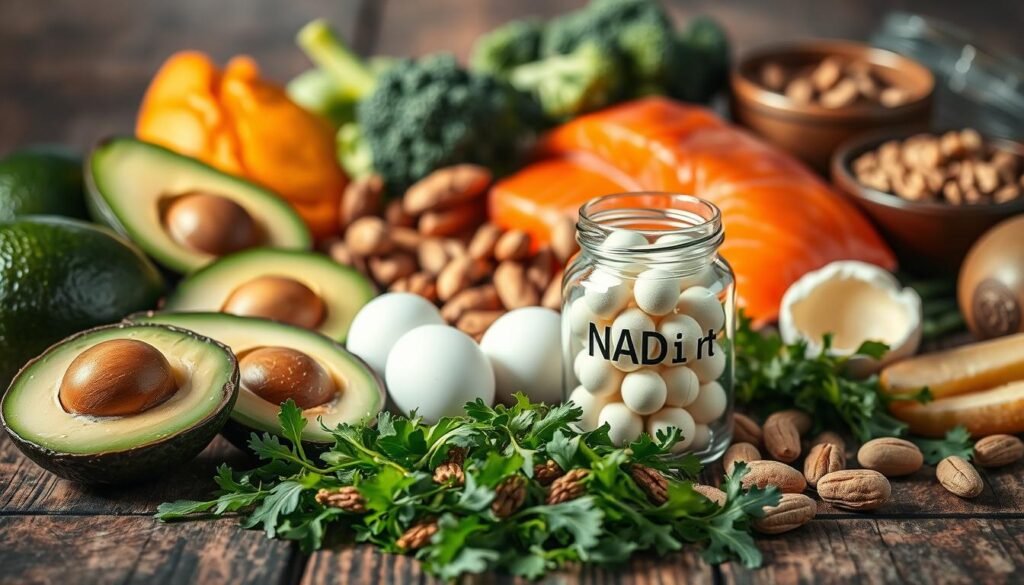
In summary, what you eat greatly affects your NAD+ levels. By choosing foods high in tryptophan and B-vitamins, you support NAD+ production. This can improve your overall health.
Many people are looking for ways to boost their NAD+ metabolism. Supplements like NR and NMN are getting a lot of attention. It’s important to know how they can help increase NAD+ levels.
NR (Nicotinamide Riboside) and NMN (β-Nicotinamide Mononucleotide) are popular NAD+ boosters. They help increase NAD+ levels by providing what the body needs to make it.
Nicotinamide Riboside (NR) is a Vitamin B3 form that boosts NAD+ levels well. Research shows it can improve how mitochondria work and help with exercise endurance.
β-Nicotinamide Mononucleotide (NMN) is another NAD+ precursor. It’s thought to be more direct in turning into NAD+, which might make it more effective.
NR and NMN seem promising, but we need to look at their safety and how well they work. Studies say they’re safe, but we’re still learning about long-term effects and the best amounts to take.
| Supplement | Potential Benefits | Current Research Status |
|---|---|---|
| NR (Nicotinamide Riboside) | Boosts NAD+ levels, improves mitochondrial function | Ongoing research on long-term effects and optimal dosage |
| NMN (β-Nicotinamide Mononucleotide) | Direct precursor to NAD+, potentially efficient NAD+ boosting | Research ongoing for efficacy and safety in humans |
As more people are interested in NAD+ supplements, it’s key to keep up with new research. Always talk to a healthcare professional before starting any supplements.
Regular physical activity greatly affects NAD+ metabolism. It’s not just good for health; it also boosts NAD+ levels. These levels are key for energy and fixing cells.
How Exercise Influences NAD+ Levels
Exercise starts many processes that raise NAD+ levels. It activates enzymes needed for NAD+ creation. It also makes mitochondria healthier, which is linked to NAD+.
Types of Exercise Beneficial for NAD+ Metabolism
To get the most from exercise, a balanced routine is key. Mix aerobic, resistance, and flexibility exercises for the best results.
| Exercise Type | NAD+ Benefits | Recommended Frequency |
|---|---|---|
| Aerobic Exercise | Improves cardiovascular health, boosts NAD+ levels | 3-4 times per week |
| Resistance Training | Enhances muscle strength, promotes NAD+ metabolism | 2-3 times per week |
| High-Intensity Interval Training (HIIT) | Efficiently improves metabolic health, increases NAD+ levels | 2-3 times per week |
In conclusion, regular exercise boosts NAD+ metabolism. Knowing which exercises help and following a good routine can improve health and well-being.
NAD+ is key to keeping our metabolism healthy. It helps with energy production and fixing cells. Changes in NAD+ levels are linked to obesity and diabetes.
Studies show NAD+ metabolism is closely tied to obesity and diabetes. In obesity, NAD+ levels drop, causing poor glucose use and insulin resistance. Diabetes also sees NAD+ levels fall, worsening the disease.
The link between NAD+ and these disorders involves complex processes. These include:
NAD+ is also crucial for cardiovascular health. Research links NAD+ loss to heart diseases like atherosclerosis and heart failure. NAD+ protects the heart by:
Learning about NAD+ in metabolic and heart health opens doors to new treatments. These could target NAD+ metabolism.
NAD+ research is on the verge of a breakthrough. New studies are showing its potential in treating diseases. Scientists are learning more about NAD+ and finding new ways to help.
Recent studies have found NAD+ is key to keeping mitochondria healthy. This is important for fighting aging. Research on NAD+ precursors shows they might improve mitochondrial function. This could help fight age-related decline.
These studies show NAD+ research is evolving fast. They point to new ways to treat diseases.
NAD+ modulation has a lot of potential. Researchers are looking into different ways to use it. One area is NAD+ supplements to boost levels. This could help with aging and metabolic diseases.
These approaches show the creativity in NAD+ research. They hold promise for better health.
NAD+ metabolism is key to keeping us healthy. Learning about it can really improve our well-being. We’ve looked at how NAD+ works, its role in aging, and its link to metabolic disorders.
NAD+ is vital for making energy, and its levels drop as we age. Eating right, taking supplements, and exercising can raise NAD+ levels. This might help us live healthier lives. Studies on NAD+ show it’s important for fighting off many diseases.
Keeping NAD+ levels up is crucial for staying healthy. By supporting NAD+ metabolism, we can work towards better health. As scientists learn more, NAD+ becomes more important for our health.


